
Mid-cap and small-cap stocks on the BSE were on the buyers' radar on Tuesday as investors booked profits in large-cap shares and the benchmark Sensex fell 264.57 points from a record close.

Automotive (auto) and auto ancillary stocks have been in the fast lane thus far in 2023-24 (FY24), with the National Stock Exchange Nifty Auto Index surging nearly 27 per cent, outperforming the Nifty50, which has gained roughly 11 per cent during this period. The top-gear performance of auto stocks at the bourses, according to A K Prabhakar, head of research at IDBI Capital, has been triggered by the premiumisation of products across vehicle manufacturers, which has seen vehicle sales remaining relatively stable. "It is not about higher sales figures now, but about premiumisation.

Don't exit from growth-style funds as they may benefit next from a shift in investor preference.

Most of the long-only funds are closed-ended. This means that investors have to lock in their money for a fixed period before they can take it back.


After disappointing guidances in the first quarter (Apr-Jun) of the 2023-24 financial year (Q1FY24) and valuation downgrades, the Indian IT sector could see some positive repricing as the bad news for IT maybe easing in Q2FY24. A key negative factor was weaker demand from the US financial sector and from North America in general. The latest GDP (gross domestic product) estimates and sector-specific news suggest that the demand situation may not be quite so bad with a gradual recovery in tech spending in Q2.

Dalal Street investors became richer by more than Rs 16.36 lakh crore this year as the equity market scaled new highs despite persistent geopolitical uncertainties and inflation worries. Analysts attributed better macroeconomic fundamentals, the confidence of retail investors and foreign investors investing again in the domestic equities towards the latter half of 2022 as the key factors that led to the outperformance of the Indian market in comparison to many other stock markets worldwide. During the initial part of the year, markets were jolted by the Russia-Ukraine war.

High dividend yield stocks usually perform well in a rising interest rate environment when investors value cash flows more.

India Inc could be embarking upon a new phase of capital expenditure (capex) cycle, observed analysts, and suggest its revival would lead to a rerating of industrial stocks. Assisted by a property upcycle, analysts at Jefferies said several government initiatives were likely to drive capex. Indicators, they said, include a private project announcement at Rs 25 trillion for 2022-23 (up 150 per cent from pre-pandemic levels) and credit growth at about 16 per cent, which is closer to pre-pandemic highs.

Investors became richer by over Rs 2.27 lakh crore on Monday as equities rebounded, with the BSE Sensex rallying over 1 per cent amid continuous foreign fund inflows and upbeat global markets. The 30-share BSE Sensex jumped 709.96 points or 1.16 per cent to settle at 61,764.25. During the day, it zoomed 799.9 points or 1.31 per cent to 61,854.19. Following the rally, the market capitalisation of BSE-listed firms jumped by Rs 2,27,794.46 crore to Rs 2,76,06,443.06 crore.

Credit Suisse analysts cut their rating on Sun Pharma stock to 'neutral' from 'outperform

'The reason being we cannot let premiums go beyond a certain point.'

Defence public sector undertakings (PSUs) have been asked by the Centre to hold roadshows in Dubai and Abu Dhabi to share their financials and business plans to reel in investors. Hindustan Aeronautics (HAL), Bharat Dynamics (BDL), Bharat Electronics (BEL), Garden Reach Shipbuilders & Engineers (GRSE), and Mishra Dhatu Nigam (MIDHANI) have informed stock exchanges that they will conduct investor outreach programmes and participate in 'non-deal' roadshows and meetings with prospective investors from September 12-15. They will share their short- and medium-term growth plans, financial metrics, improvement in their stock performance/ market capitalisation - and make a pitch of sorts to prospective investors.

The 55 basis point (bps) spike in the US 10-year bond yield, triggered by a combination of FOMC's hawkish commentary and BOJ's relaxation of the yield control curve (YCC) has made analysts cautious on Asian equities and expect them to trade sideways in the short-to-medium term.
ITC has been one of the best performing large-cap stock at the bourses thus far in calendar year 2022 (CY22), rallying nearly 52 per cent during this period and outperforming the sector benchmark - the S&P BSE FMCG index - by a wide margin that moved up around 17 per cent during this period. However, the counter has lost over 5 per cent from its recent high of Rs 346.25 hit on September 23, 2022 and has underperformed the S&P BSE Sensex, which has lost nearly 2 per cent since then. So, is the rally in the stock coming to an end, and is this a good time to book profit?

After a stellar run that saw the frontline indices - the S&P BSE Sensex and the Nifty 50 - clock gains of around 21 per cent and 24 per cent respectively in calendar year 2021 (CY21), the year gone by in real sense belonged to the mid-and small-cap segments. Thus far in CY21, the mid-and small-cap indexes on the BSE have far outpaced the run in the frontline indices and notched up a gain of around 38 per cent and 61 per cent, respectively during this period. Though analysts expect the outperformance to continue in 2022, they caution against the multiple headwinds in the year ahead that may dent the overall market sentiment.

Benchmark indices Sensex and Nifty gave up early gains to close in negative territory on Thursday dragged down by IT and pharma stocks which fell amid fears of recession in the global economy. The 30-share Sensex opened higher and rose further to touch a day's high of 60,676.12 on gains in auto and capital goods shares. However, it gave up all early gains and later closed 412.96 points or 0.68 per cent lower at 59,934.01.

Benchmark indices continued to rally for the third day running on Friday with the Sensex climbing 619 points in early trade to reclaim the 57,000 level. The 30-share BSE benchmark jumped 619.27 points to 57,477.06. The broader NSE Nifty advanced 189.15 points to 17,118.75.

Among the Sensex firms, Bajaj Finserv, Tata Motors, Asian Paints, ITC, IndusInd Bank, State Bank of India, Tata Steel, Wipro, Infosys and Maruti were the major gainers. Tech Mahindra, HCL Technologies, Kotak Mahindra Bank, Titan and Larsen & Toubro were the major laggards.

The third-quarter financials didn't excite market watchers. But equity investors can still make money if they invest in the right stocks.

Riding on an improved show across parameters, TVS Motor (TVS) outperformed larger two-wheeler peers Hero MotoCorp (Hero) and Bajaj Auto (Bajaj) during the September (Q2 of FY23) quarter. The Chennai-based firm, which has the most-diversified portfolio among two-wheeler majors, posted a 28 per cent jump in revenues. This compares to 18 per cent growth for Bajaj Auto and single-digit uptick for Hero MotoCorp.
Subex Systems has risen 35.46 per cent from Rs 83.60 touched on 31 March to Rs 113.75 on May 9.

Bajaj Finance's quarterly business update, coupled with around 24 per cent fall over the past six months, has turned risk-reward favourable for investors, observe analysts. They see up to 39 per cent upside in the stock, from a one-year perspective. Global brokerage CLSA, for instance, has upgraded the stock from 'underperform' to 'outperform' with an increased one-year target price of Rs 6,600 (vs Rs 6,000 earlier) as it believes the risk-reward has turned favourable for the counter, and there is scope for expansion if growth remains robust.

Small-cap stocks raked in big gains in fiscal 2021-22 by giving up to 36.64 per cent returns, outshining the bigger benchmark gauge and experts believe that they may continue to outperform in FY23. Markets faced many headwinds in the latter part of the last fiscal with the emergence of geopolitical tension, inflation concerns and FII selling. Analysts said that the first half of the last fiscal was very good, while the market entered into consolidation in the second half, combined with high volatility.

Fresh buying by domestic institutional investors and better-than-expected June quarter results from some blue-chip companies boosted investor sentiment

Equity benchmark indices rallied nearly 1 per cent to re-visit the 59,000-mark on Monday, tracking heavy buying in index heavyweights Reliance Industries and ICICI Bank. The BSE benchmark rose 442.65 points or 0.75 per cent to settle at 59,245.98. During the day, it jumped 504.92 points or 0.85 per cent to 59,308.25.

Among top losers that dragged down key indices were Infosys, TCS, Reliance, SBI, Tata Steel and ITC, falling up to 2.15 per cent.

The FMCG sector is generally considered to be a safe haven during difficult times as people never stop buying soap and toothpaste. However, weak rural and semi-urban demand has been a factor since the lockdowns of 2020-21 while rising inflation has also impacted margins. While the FMCG majors have survived on the basis of price hikes and good management practices, they have seen growth slowdowns and experienced margins being squeezed as raw materials and transport costs rose. The FMCG sector witnessed positive volume growth in the fourth quarter of the 2022-23 financial year (Q4FY23) after five consecutive quarters of decline, and the rebound in demand was led by urban markets.

Investors' wealth eroded by over Rs 4.90 lakh crore on Friday amid a sharp fall in equities. The 30-share BSE Sensex tanked 1,020.80 points or 1.73 per cent to settle at 58,098.92. During the day, it tumbled 1,137.77 points or 1.92 per cent to 57,981.95. The market capitalisation of the BSE-listed firms plummeted by Rs 4,90,162.55 crore to Rs 2,76,64,566.79 crore on Friday.

State Bank of India's earnings growth may turn lacklustre in the near-term, warn analysts. This, they said, could be due to margin compression and likely lower fee income over the next one year. "While the cost of deposits is repricing sharply across the system, there will be relatively lower yield expansion going ahead as most of the back-book has been repriced and there is a high competitive pressure on yields.

Auto Expo 2023 may not trigger a fresh rally in automobile stocks, say analysts, as this year's edition lacks participation from major listed players. It is also owing to the focus on electric vehicles (EVs), a segment where four-wheelers have minuscule market share. "In the passenger vehicles (PV) segment, Maruti Suzuki India and Tata Motors are the only listed players.

After lagging behind other segments in the automotive (auto) space over the past few years, two-wheelers are expected to reverse their volume underperformance. After witnessing a 36.3 per cent volume decline over the 2018-19 (FY19) through 2021-22 (FY22) periods, the sector staged a recovery in 2022-23 (FY23), with volumes rising 17 per cent. While volumes are still a quarter lower than the FY19 peak of 21 million units, a double-digit growth trajectory is expected to prolong.

The impact of the banking crisis in the US was visible in IT bellwether Tata Consultancy Services' (TCS) weak performance in the March quarter of fiscal 2023 (Q4FY23). The firm witnessed slower revenue growth in Q4FY23 and failed to meet its FY23 exit Ebit margin of 25 per cent as some clients, especially in the North American region, took to pausing projects and rising onsite costs offset utilisation gains. Sequentially, the company's revenue grew by just 0.6 per cent on a constant currency basis, which was one of the slowest paces in over 11 quarters.

The success of recent IPOs and the stability in the secondary market are propelling many firms and investment bankers to remove their IPO plans.
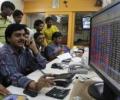
Markets ended lower for the third straight day on Tuesday weighed down by profit taking in rate sensitives with bank shares leading the decline after hopes of rate cut by the central bank faded.
BSE small-cap index, which ended over 1% higher, outperformed the benchmarks significantly.

Smaller stocks have continued to give higher returns to equity investors so far this fiscal, significantly outperforming bigger peers on indices. The BSE smallcap index has zoomed 7,333.47 points or 35.51 per cent, while midcap index has jumped 5,096.41 points or 25.25 per cent so far this fiscal. In comparison, the 30-share BSE benchmark Sensex has gained 9,797.78 points or 19.78 per cent.
A spate of recent orders under the Indigenously Designed Developed and Manufactured (IDDM) category have led to investor focus on defence stocks. Actually, the defence index has been an outperformer for a long while with public sector undertakings (PSUs) like Hindustan Aeronautics (HAL), Bharat Electronics (BEL), Bharat Dynamics (BDL), Garden Reach Shipbuilders Engineers (GRSE), Cochin Shipyard and Goa Shipyard being beneficiaries of the policy.

Despite taking a hit on profitability amid the pandemic, companies with strong balance sheets are gaining market share because of consolidation in their respective sectors.

All the sectoral indices, led by realty, metal, consumer durables and power were trading in the negative zone on Thursday.
 © 2026 Rediff.com - Investor Information - Advertise with us - Disclaimer - Privacy Policy - Sitemap - Feedback - About us - Terms of use - Grievances